The three skills behind lasting longer, and how to train each
Control is three skills, not one
Most advice treats lasting longer as a single trick to discover — a breathing pattern, a distraction, a thing to tense. That framing is why the advice keeps failing. What people call “control” is really three distinct capacities, and they are trained separately:
- Arousal awareness — noticing where you are on the curve, early enough to act.
- Nervous system regulation — being able to settle your breathing and stay physically calm on demand.
- Whole-body sensitivity — distributing attention and sensation beyond one point of focus.
Work on one and you plateau. The reason has nothing to do with willpower: each skill fails in a different way, so training only one leaves the other two failure modes intact.
Arousal awareness: knowing the curve
The core problem is not that arousal rises. It is that most men only notice it at the point where it is no longer negotiable. By then the options are gone.
Deliberate edging practice is how you learn the curve — approaching the threshold, recognising the signals that precede it, and backing off before it becomes inevitable. Repeated, this moves your recognition point earlier. That earlier recognition is the whole game, because everything else you might do only works if you start it in time.
What makes it training rather than guesswork is structure: approaching the threshold on purpose, a known number of times, and paying attention to the signals rather than just getting through it.
Nervous system regulation: practised in advance
Arousal and the stress response share machinery. Breathing gets shallow and fast, muscles tighten, and both of those feed back and accelerate things further.
The mistake is treating breathwork as something you deploy in the moment. A technique you have never practised is not available to you under pressure — you will not execute a novel skill for the first time in the one situation where you are least composed. It has to be rehearsed cold, repeatedly, until slow breathing and a relaxed pelvic floor are the default rather than something you have to remember to do.
This is the least glamorous of the three and probably the highest-yield.
Whole-body sensitivity: spreading the load
When all sensation is concentrated in one place, that place sets the pace. Sensory training works the other direction — deliberately building awareness across the whole body so attention is not locked in one spot.
The practical effect is twofold. There is less overwhelming input from one source, and you gain somewhere else to put your attention that is not distraction. Mental distraction works briefly and costs you presence, which is usually the thing you were trying to protect.
Why six weeks, and why logging it
These are physical skills, and physical skills consolidate through repetition spaced over time. A concentrated weekend of effort does not produce the same adaptation as the same total effort spread across weeks — that is true of strength training and it is true here.
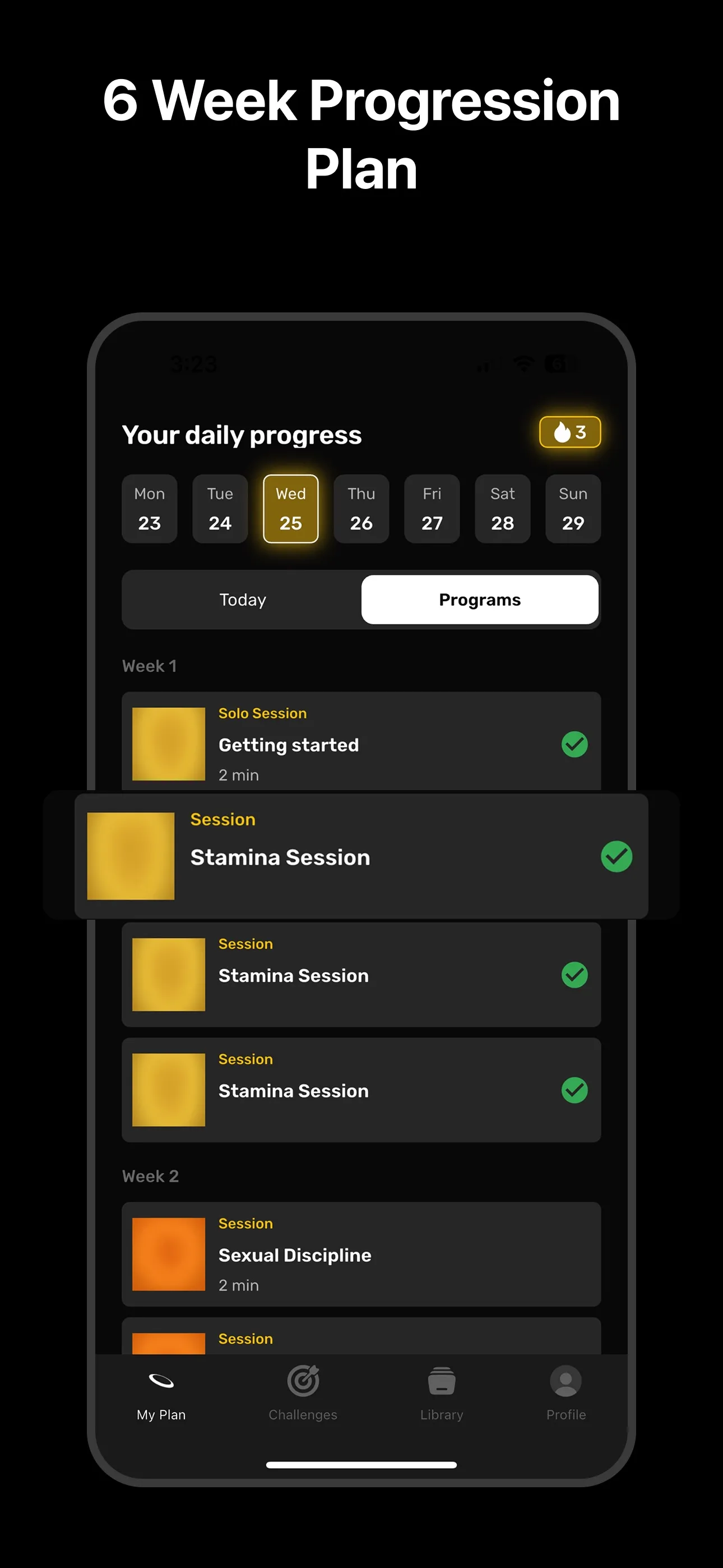
Which is why tracking matters more than it seems. Consistency is the variable that actually moves these three skills, and it is also the one people misremember. Ticking off sessions turns “I’ve been working on it” into something you can look at.
What this is not
This is training and education, not medical care. Persistent difficulty can have physical or psychological causes that a structured practice routine will not address, and some of them are treatable. If something feels wrong rather than just untrained, talk to a doctor — that is a reasonable first step, not a last resort.
Outlast builds these three pillars into a six-week progression: guided edging sessions, breathwork and relaxation practice, full-body sensory exercises, and an accountability page that tracks what you have actually completed. Free to download, on iPhone and Android.